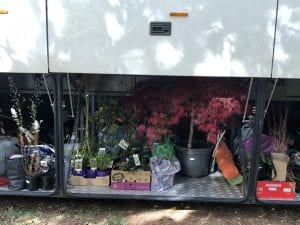
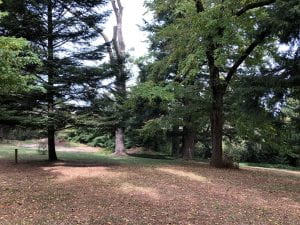
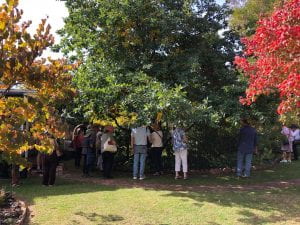
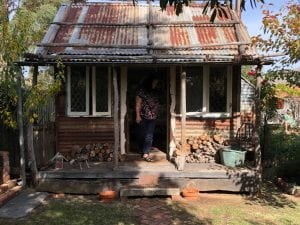
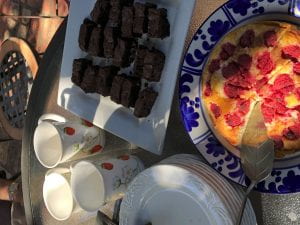
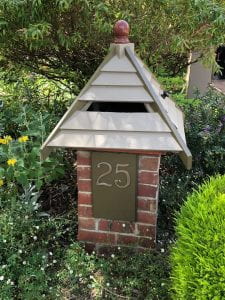
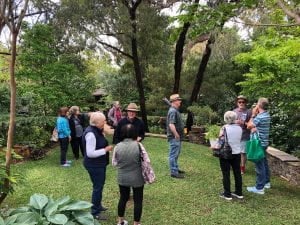
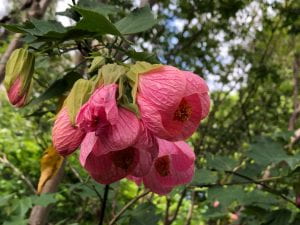
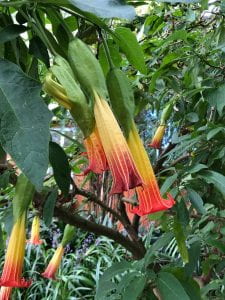
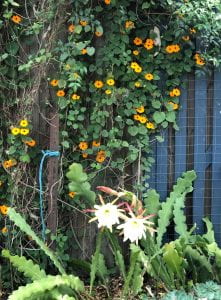
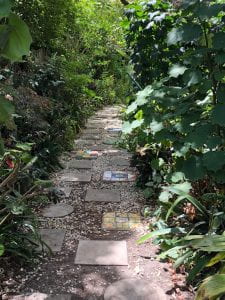
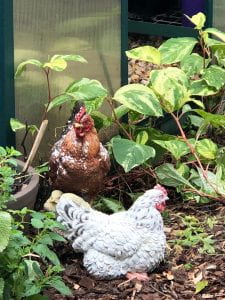
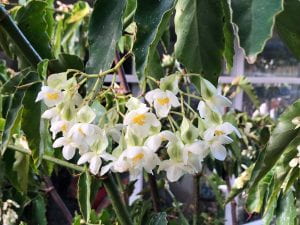
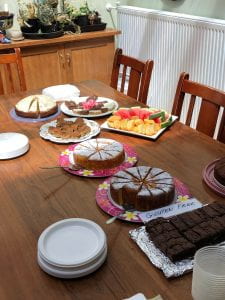
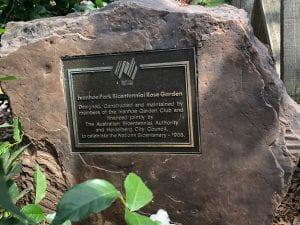
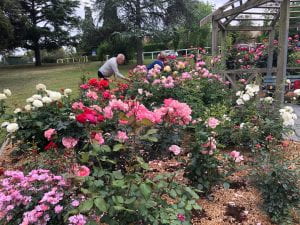
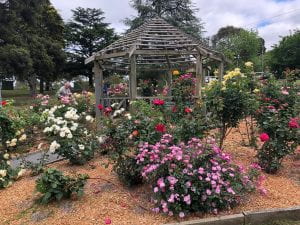
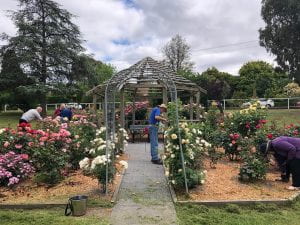
Recently, the Ivanhoe Garden Club held its very popular Progressive Garden Party. This wonderful event has us visiting three gardens with lovely food at each. Thank you to all of those who offered their beautiful gardens and to those who arranged the excellent food. We were lucky with the weather and had a great time enjoying three very different gardens.
The following words are descriptions of each garden from the Progressive Garden Party ticket. The accompanying photos were taken on the day.
Garden One – Connie’s garden, Thornbury

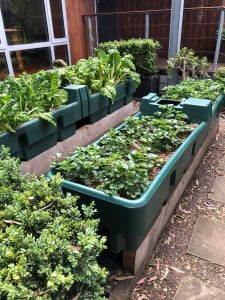
“I enjoy the process of repurposing materials for use in the permaculture garden. At the front, mosaic bathtubs are adorned with strawberries, there are various fruit trees and a coup for the hens – a novelty for passersby, but their main purpose = great eggs!
Periodically, they are let out to enjoy the garden greens and to scrounge around. The back is quasi-divided into rooms. A central area has an encircled net to safeguard produce from extreme winds. A New Zealand laurel, a gleditsia sunburst and an avocado tree provide a canopy.
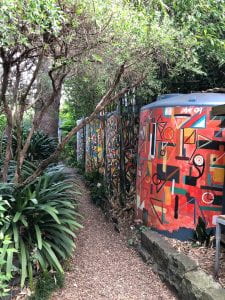
Quirky items are dotted throughout the garden. The goldfish are happy to share their pond with water plants. A grotto was fun to set up this year.”

Garden Two – Jane’s Garden, Eaglemont
“The garden of this 1902 house has an eclectic mix of native and exotic vegetation, together with a wide variety of annuals and perennials that provide year-round colour and texture. The garden is set out on multiple levels, with a winding stone stepped path with an illuminated handrail, together with retaining walls, terraces and paved areas.
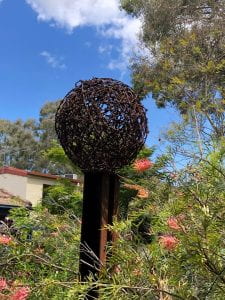
Plants include many varieties of grevilleas, correas, salvias, bulbs, roses, irises, orchids and bromeliads. Two wisterias climb handcrafted supports. The high stone wall beside the barbeque was built by renowned and now retired stone mason, John Kellett. The remaining hard landscaping was crafted by heritage accredited Tasmanian Craig Williams and his young apprentice Xaviar Wilson.
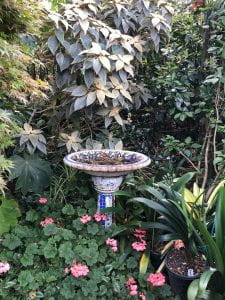
Completion took a year and included the removal of the top sloping lawn and its replacement garden, as well as the hand carved Tasmanian sandstone bird bath, based on a 1930s Annear designed sundial. The wide variety of species attracts many insects, as w ell as small native birds, due to the dense vegetation cover and nectar-producing flowers.
I continue to be assisted with the choice and procurement of many of the plant varieties by Robyn Roberts, a true gardening friend. I also employ an outstanding gardener, Gavin, on a weekly basis. My garden has been my joy and salvation. “

Garden Three – Eleneth’s Garden,. Eaglemont

“We have lived at Glen Drive for 34 years. The previous owners had established the garden when the house was built in 1958. The garden was typical – camellias, rhododendrons, azaleas, and deciduous trees, including ginkgo, copper beech, Queensland box, maples, Chinese elm and various cypress. This planting had become too water-intensive, and many plants were no longer suitable in today’s drier and hotter conditions. The old design of the house and garden had become outdated; a traditional layout featured a front garden and a back garden that were separate, discrete places.
Once our children left home, we decided to rebuild in 2020. One feature was to integrate the garden with the house, optimising the views of the garden from the house. The house site was moved to sit on a contour line across the block, giving the building a natural height. House and garden design features included the use of timber outside the house and Castlemaine slate for pathways. Each room is designed to offer a view of the garden. For example, the back central garden bed is at window height and can be enjoyed from the bedroom window. The crepe myrtles have a vase shape and are underplanted with swaying native grasses.
We planted to suit the microclimates that had naturally evolved. The front garden was particularly difficult as it faces due west, very hot in summer, but receives almost no sun in winter. We have resolved this by using dark foliage shrubs and deciduous trees.
We’ve preserved as much as possible, camellias and large established trees. New plantings have been chosen with minimal water needs and drought resilience. Hence, leucadendrons, leptospermums, and many different textures of native and other grasses. We have honoured the original heritage with new deciduous plantings: cornus (dogwood), cotinus (smoke bushes), hamamelis (witch hazel), maples and tree pansies are featured trees. We try to minimise watering – with a drip irrigation system. We paid attention to improving the soil quality and established a natural composting system. Despite a lot of time spent in the garden, we still feel it is not yet”